Tuesday, September 28, 2010

Day 9 -- Oleiros & Betanzos


On a vacation schedule with no commitments we slept late. We walked around the area where the hotel is located. It is on a bluff overlooking a bay and there are many large houses. One in particular is amazing. It looks like a half-dome with a terrace protruding towards the coast. It is still under construction.
We then set out for Batanzos, about 10 km from Oleiros. The guide book touted it as a picturesque place. The old medieval town is hilly like San Francisco. It is walled in and surrounded by two rivers, which meet right outside the city walls. There was a farmers market there so we bought some fresh figs, which are really abundant and delicious here, and some tomatoes. We walked around and then found a tapas place for lunch/comida.
After returning to our hotel we first went to a sales office of a new development a couple of blocks away. We wanted to find out what the prices were around here. The sales lady took us on a tour of the apartments. This company built three buildings with six apartments each. Two buildings are sold out, and the one that is left will be ready in March 2011. The apartments are about 85 square meters, but terribly cut up into small spaces. The building quality is quite high but so is the price -- 320,000 euros per apartment. Not for us. Then we went on a long walk to two beaches. The area here is very pretty. The walking and biking trails along the coast that lead from beach to beach are beautiful and we can definitely understand why it would be a very desirable area to live.
In the meantime, Ana from Ourense contacted us about a house that looks really good so we will go and see it tomorrow. We also have another house to see near Pontevedra and potentially another one near Lugo.

Monday, September 27, 2010

Day 8 - A Coruna & Oleiros


We spent the morning in our great Laxe hotel ( whenever you are in Laxe make sure you stay at Playa de Laxe) picking a hotel in our next stop (A Coruña). We picked one from a list of all hotels in Galicia in a town on the outskirts of A Coruña. We checked out of our hotel and started driving toward A Coruña. It was an easy drive. The hotel we picked in the town of Oleiros is a gem. It is a studio apartment including a kitchen, an eating area with table and 2 chairs, a large bedroom with a bed, desk and chair, and a coffee table with 2 easy chairs. All this for about $60. We were so impressed we booked a second night.
We then drove into A Coruña. This is the biggest city of Galicia with about 300,000 people, a lot of industry and one of the largest ports in Spain. Of course it has its peninsula and both waterfronts are magnificent. It has a fairly small, but pretty old town, and some nice pedestrian streets lined with shops. Bo did some shopping. We had our comida, walked around for a couple more hours and returned to our base in Oleiros. We walked along the Oleiros waterfront and sunset. It is on the other side of the bay, exactly opposite A Coruna so the view of the lit city is magnificent. We also passed some amazing houses here. We think that Oleiros is to A Coruna what Sausalito is to San Francisco (well, maybe not quite, but at least in terms of the view).
Just a note about food here --- we’ve been shopping for wine an snacks from time to time and the selection and prices of wine are amazing. You can get a bottle of wine for as little as 69 euro cents (about $1). The bread is fantastic, not to mention a huge selection of wonderful cheeses and very tasty chorizo sausages. They also have amazing peaches, plums and grapes in season now. We’ve been eating well.

Sunday, September 26, 2010

Day 7 -- Coast of Death (Costa da Muerte)


This part of the coast is named Coast of Death for the treacherous coast line and the many shipwrecks which happened here (some caused by natives with erroneous signals for ships). The coastline is not straight but jagged with peninsulas and bays. After the morning coffee (mornings start after 10 am here), we set out driving along the coast toward the little town of Camarenas about 20 km from Laxe. The first stop was at a small fishing village of Camallo where a German man built a tiny house on the edge of the water and garishly decorated the land around with dozens of “sculptures” made of local stones. The largest oil spill in Spain in 2002 devastated it and he died soon after, the legend says of sorrow that his beloved pristine coast was damaged. There is a museums there in his honor. From there we drove up and up on a very narrow road with the sea on one side way down below. The views were absolutely spectacular. We were looking for a site called Cementerio de los Ingleses -- a cemetery of hundreds of English travelers killed in the shipwreck in the 19th century. We followed a sign towards the cementario, but the road soon changed into what looked like an unpaved walking path and there was even a sign there saying that it was a pedestrian route. Al wanted to continue, but Bo got scared that there will be no place to turn around later and wanted to go back to the paved road. That’s what we did and followed it to the bigger fishing village of Camarenas, which is know for lace making and its lighthouse. We drove to the lighthouse first, an imposing structure high up at the very tip of the peninsula. There was a field of windmills on one side of it and a big salt plant on the other. We had lunch/comida of fish empanadas and a platter of clams and drove back to Laxe We parked the car by the hotel, had a little rest and set out for a hike to Playa de Soeste, a secluded beach about 3 km away. Laxe is on a peninsula with ocean on 3 sides. Our 6 km hike took us over a hill to the other side. The scenery was magnificent. On the way we met a group of hikers, but the beach was totally empty. We spent some time walking on the white sand. The water was pretty cold and it got quite windy so after a short rest we walked back to Laxe.
Dinner (or rather the evening meal) here starts at 8 pm so after 8 we walked down to a tapas place by the beach and had mussels and fish croquettes with wine (Bo) and beer (Al). All drinks in tapas bars are served with little snacks for which they don’t charge. Sometimes it’s a tiny roll with local sausage, sometimes baked sardines with potatoes, sometimes little bowls of potato salad or a meat ball; this evening we got slices of cheese with sardines on top.

Saturday, September 25, 2010

Day 6 -- Costa da Muerte, Laxe


We left Ames (suburb of Santiago de Compostela) in the morning and headed for the coast. We were on secondary roads but they are very good. After less than 2 hours we arrived at Laxe. It is a sleepy beach town. It is very picturesque but not very lively. Our hotel is wonderful. After the previous 3 sparse hotels this one is paradise. Right on the beach and the room is huge and very tastefully decorated + has a fridge and a jacuzzi. After we checked in, the receptionist gave a booklet with walking trails. There are a lot of them in the area. We decided to take a short one (5 km) called the Faro trail around a small hilly peninsular before lunch. It was very easy at first, but then somehow we got off the trail and it became very, very steep and difficult. There was no turning back so we kept climbing until we reached the highest point with a small lighthouse. Bo’s hand was bleeding because on the way up she tried to hold on to something and grabbed a very thorny plant. The way back to the village only took a few minutes because we took an easy paved road through the middle. Then we went to a tapas bar and had a plate of mussels, fresh sardines with potatoes and a plate of octopus. Fresh octopus is a big specialty of this area, but the big plate we had definitely took care of our yearly needs.
In the afternoon we took another trail through the village to a small church of Santa Rosa de Lima on a hill overlooking the bay. The views were gorgeous from there. On the way, we met a young German pilgrim who has been walking since August. He came from Santiago via a coastal route and couldn’t say enough about the beauty of the Galician coast.

At 9 pm Mark and his wife and two lovely daughters, Susie and Belinda came to pick us up at the hotel and we went out to dinner. We had fantastic mariscos -- marinated fresh salmon and cod, two kinds of clams and razor fish + salad, bread, cheese and wine. The food was delicious. Luckily the restaurant was right in front of our hotel so we didn’t have to drive home.

Friday, September 24, 2010

Day 5 -- Santiago de Compostela


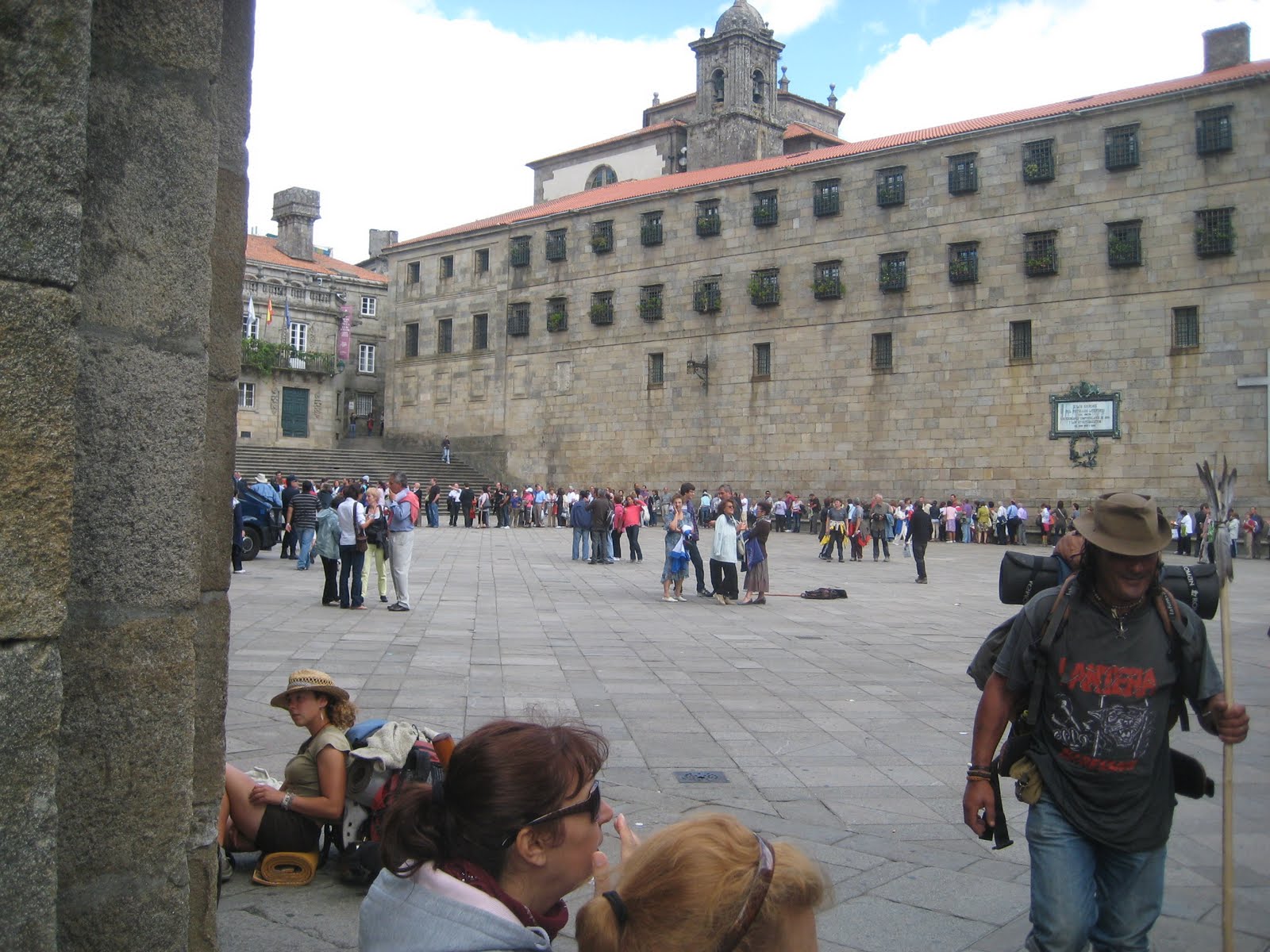
Morning in Orense was uneventful. However, we managed to sneak into the Cathedral right after mass. It is spectacular. The amount of gold is unbelievable. We were lucky since as we were leaving, the lights were being turned off and the glistening gold all around became dark. The drive to Santiago was on a nice toll road going through a lovely green, hilly or mountainous terrain. It was an easy drive, but the situation changed radically when we got to Santiago. Driving through a maze of narrow medieval streets, most of which are one way and totally crowded with cars and people is next to impossible. In addition to that, our GPS lady doesn’t do cities very well so we often drive around in circles. So we gave up trying to get anywhere and parked in an underground garage and began walking. As soon as we got near the Cathedral the crowds were overwhelming. Hoards of people do a pilgrimage to this city from all over all the time. The pilgrims routes are called “Camino de Santiago” and thousands of pilgrims eventually get into the city. You can see them wearing hiking boots, carrying backpacks and walking sticks. They are young and old. They probably take up at least half of the available hotel rooms. They congregate around the famous cathedral, which is immense and architecturally spectacular, but the line to go inside was unending. The whole city is a gem with its amazing architecture and history. It’s a bit too crowded for our taste, though.
Hotel --- we didn’t even think about making a reservation because after all late September is not the prime tourist season. Our attempt to find a hotel was disappointing to say the least. We tried every hotel we saw, even the most expensive place in town where the room is hundreds of euros, but there was not a vacant hotel room in the entire city. The local tourist information office gave us a book with a list of all the hotels in Galicia arranged by city. We looked at a map and chose the closest city on our itinerary towards the coast, called a hotel and booked a room. Tourist information also helped us find the only vegetarian restaurant in the city -- comida ecologica. We have never been so excited about a salad. After eating heavy and meaty Galician food for days, this was heaven.
We finally got back to our car (after having to ask for directions about 5 times). Driving out of the underground parking turned into one of the most horrifying experiences ever. In a very narrow driveway full of very sharp turns we were suddenly faced by another car going down as we were driving up. We thought that for sure he must have made a mistake. We hoped he would back out, but there was another car behind him. We couldn’t move either because there were at least two cars behind us. All this took place on a steep stretch so sliding down seemed like a real possibility. Finally, the car facing us managed to move as far to the wall as possible and we barely passed it and got out. We found our hotel in a brand new suburb about 3 miles away from Santiago. It is modern, clean and quite comfortable.

Thursday, September 23, 2010

Day 4 -- Ourense


We left the hotel after the sparse breakfast. Culinary wonders is not a strong suit in Galicia. (the woman was going to pour coffee into the bowl of corn flakes). We drove through the winding roads and found a house that a neighbor said was for sale. It was a lovely big house with a walled-in yard with a very big swimming pool. The location was perfect so we went to our friend Mark’s house to see if he could show it to us. He told us it was sold but took us to another house instead. This house was in the village of Rabade, on the main street. We actually liked this one very much. It is an old stone house hidden under an ugly purple façade. It is pretty big and has a lot of potential even though it needs a lot of work. It has a good size garden and a small barn where Al could have his workshop. This one may be worth considering.

We then drove to the city of Orense - about 60 miles away. On the way Bo called a realtor who agreed to meet us at 4 pm. Ana, the young and fun realtor, then took us to see 4 houses. One was right on the river and you could launch a boat from the property. Unfortunately, the house was not good because it needed a complete overhaul and was on the main road. The next two were so remote they were not acceptable. The final house and property were spectacular. It was like a park. It had a swimming pool, palm trees, vineyards, fountains… Unfortunately the beautiful house had only one bedroom. This burst our bubble. None of the houses she showed us worked out, but we got to practice Spanish with her all afternoon.
Back in Ourense we are enjoying the local night crowd in the outdoor cafes. The historical center of he city is small but really beautiful -- a maze of narrow streets with several gorgeous churches sprinkled here and there.
N.B. Galicia is bilingual. The native population speak Gallego as their primary language but all speak Spanish also.
On the drive to Galicia we passed myriads of solar panel farms. Spain appears to be serious about ecology.

Wednesday, September 22, 2010

Day 3 Ribeira Sacra


The day started with oversleep. We awoke at 10 am - the appointed time for our meeting with Mark, the realtor. He met us at the hotel while we were having breakfast. Then he drove us to his house, which is a traditional Galician stone house that he rebuilt himself from almost a ruin. Then, we sat down in his office and picked houses to see that met our criteria. There weren’t that many of them --- maybe 8 or 9, and most were located near the town of Chantada, in the area called Ribeira Sacra. We decided to see those 5 first so we got into Mark’s car and drove there. On the way we stopped in the village of Monterroso to pick up keys and information from Maribel, Mark’s associate and have comida in a local restaurant. The restaurant was completely full and served a fixed menu with just a few selections. We had beer and wine made by the owner with barbecued ribs and local sausage, salad and home made pastry served with chocolate liqueur. Then we set out to see the houses:
House #1--- about 5 km from Chantada was not a traditional stone house, fairly modern, 3 bedrooms, 2 baths, nice big lot, but nothing remarkable.
House #2 --- also about 5-6 km from Chantada, traditional Galician house owned by two English women was in a little hamlet of 5-6 stone houses; it was small but livable and had a gorgeous stone barn that could be converted to a living area + a nice big lot. Has potential.
House #3 --- located in a beautiful countryside, but with nothing close by was a big (5 bedrooms, 2 baths) fairly modern house with a large garden and orchard. Too big and too expensive and too remote.
House #4 --- an amazing piece of property perched high up on a hillside overlooking one of the most spectacular views imaginable, including mountains cut through by a river and a large dam. It also includes acres of producing vineyards that bring in some income with local people doing all the work. The house itself is pretty large, but needs a complete overhaul.
House #5 --- a huge stately stone house in the middle of nowhere with two barns and a big piece of land. It was priced quite high and needed a complete overhaul too.
So far none of them spoke to us.
We will continue our search in a slightly different area of Galicia and hopefully find something that does.